Confidential - Do not share without permission

Back
Confidential - Do not share without permission
Back

Performance
-
-
Developing prescription aging medicines using epigenetic reprogramming, aiming to restore youthful function in aged cells while preserving their tissue identity. Its lead program is an LNP-RNA liver aging medicine, with broader ambitions across liver/metabolism, vascular, and immune systems. The company combines AI-guided transcription-factor discovery, high-throughput wet-lab screening, single-cell genomics, and proprietary datasets to build a scalable platform for tissue-specific age-reprogramming medicines.
Memo Highlights


Confidential
Do not share
Deck only available via Desktop
Highlights
NewLimit is a biotechnology company developing “aging medicines” using epigenetic reprogramming, with the ambition of restoring youthful function in specific tissues rather than merely slowing age-related decline.
The company’s stated mission is to “radically extend human healthspan.” Its core thesis is that aging can be treated at the cellular level by reprogramming the epigenome: resetting aged cells toward a more youthful functional state while preserving their identity as liver cells, immune cells, vascular cells, or other mature tissue types.
NewLimit’s long-term goal is to build medicines that add many healthy years of life across liver, vascular, immune, and other aging-related systems. If successful, NewLimit could create a new category of tissue-specific aging medicines, starting with liver disease and expanding into other major age-related disease areas.
The company was founded by Jacob Kimmel (epigenetic reprogramming at Calico), Brian Armstrong (co-founder and CEO of Coinbase), and Blake Byers (scientist, investor, and former GV partner). NewLimit is now one of the best-funded companies in longevity biotech, following a $435 million Series C in June 2026 at a reported valuation of approximately $3.1 billion.
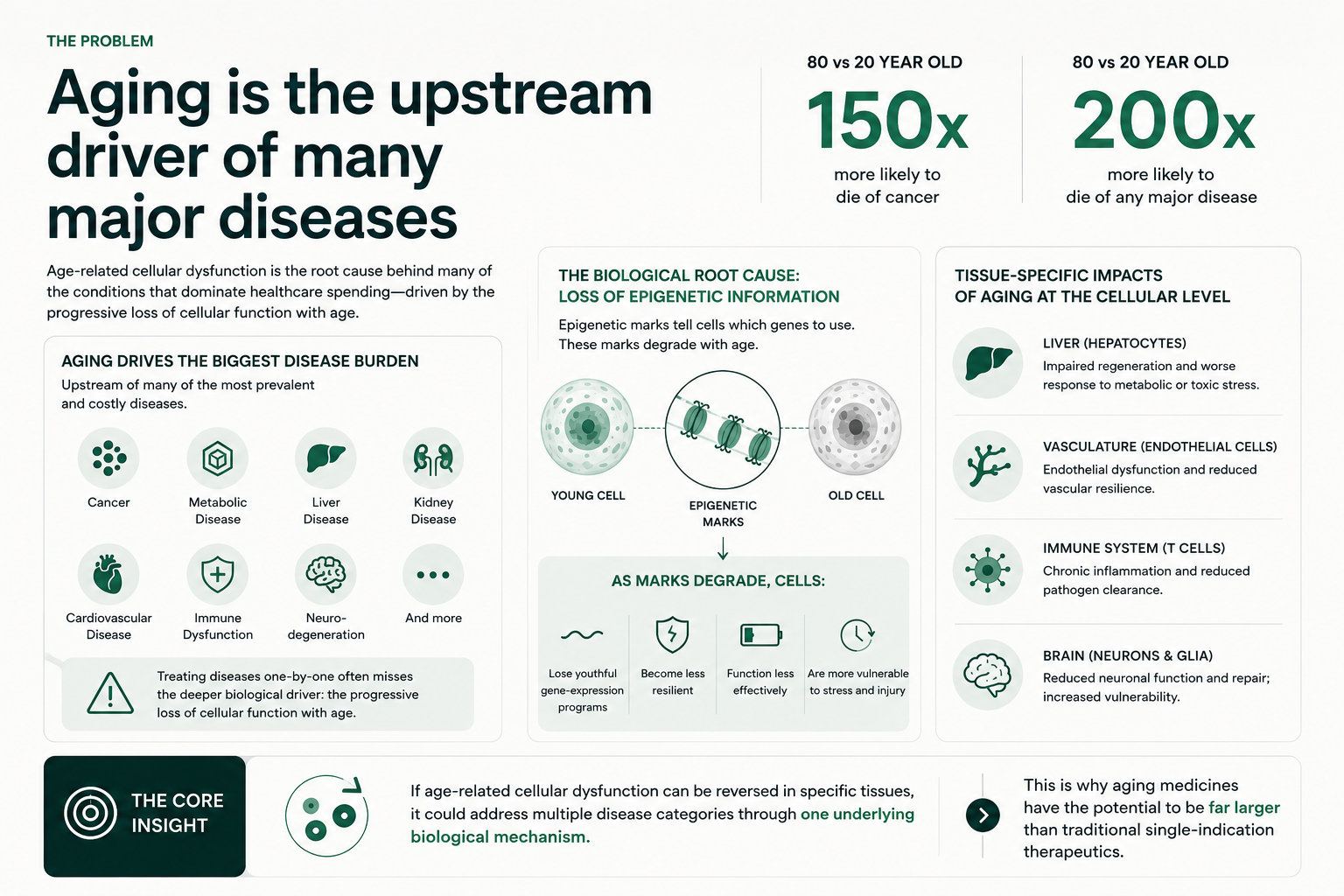
Aging is an upstream driver of many major diseases. NewLimit frames age-related cellular dysfunction as a root cause behind many of the conditions that dominate healthcare spending, including cancer, metabolic disease, liver disease, kidney disease, cardiovascular disease, immune dysfunction, and neurodegeneration.
The company claims that an 80-year-old versus a 20-year-old is approximately 150x more likely to die of cancer and 200x more likely to die of any major disease. The implication is that treating individual diseases one-by-one may miss the deeper biological driver: the progressive loss of cellular function with age.
At the cellular level, NewLimit’s premise is that aging is driven in part by degradation of epigenetic marks. NewLimit explains that epigenetic marks tell cells which genes to use, and that these marks degrade with age. As these marks degrade, cells can lose youthful gene-expression programs, become less resilient, and function less effectively. In the liver, this may mean impaired regeneration and worse response to metabolic or toxic stress. In the vasculature, it may mean endothelial dysfunction. In the immune system, it may mean chronic inflammation and reduced pathogen clearance.
If age-related cellular dysfunction can be reversed in specific tissues, NewLimit believes this could address multiple disease categories through one underlying biological mechanism. This is the core reason the company views aging medicines as potentially much larger than traditional single-indication therapeutics.
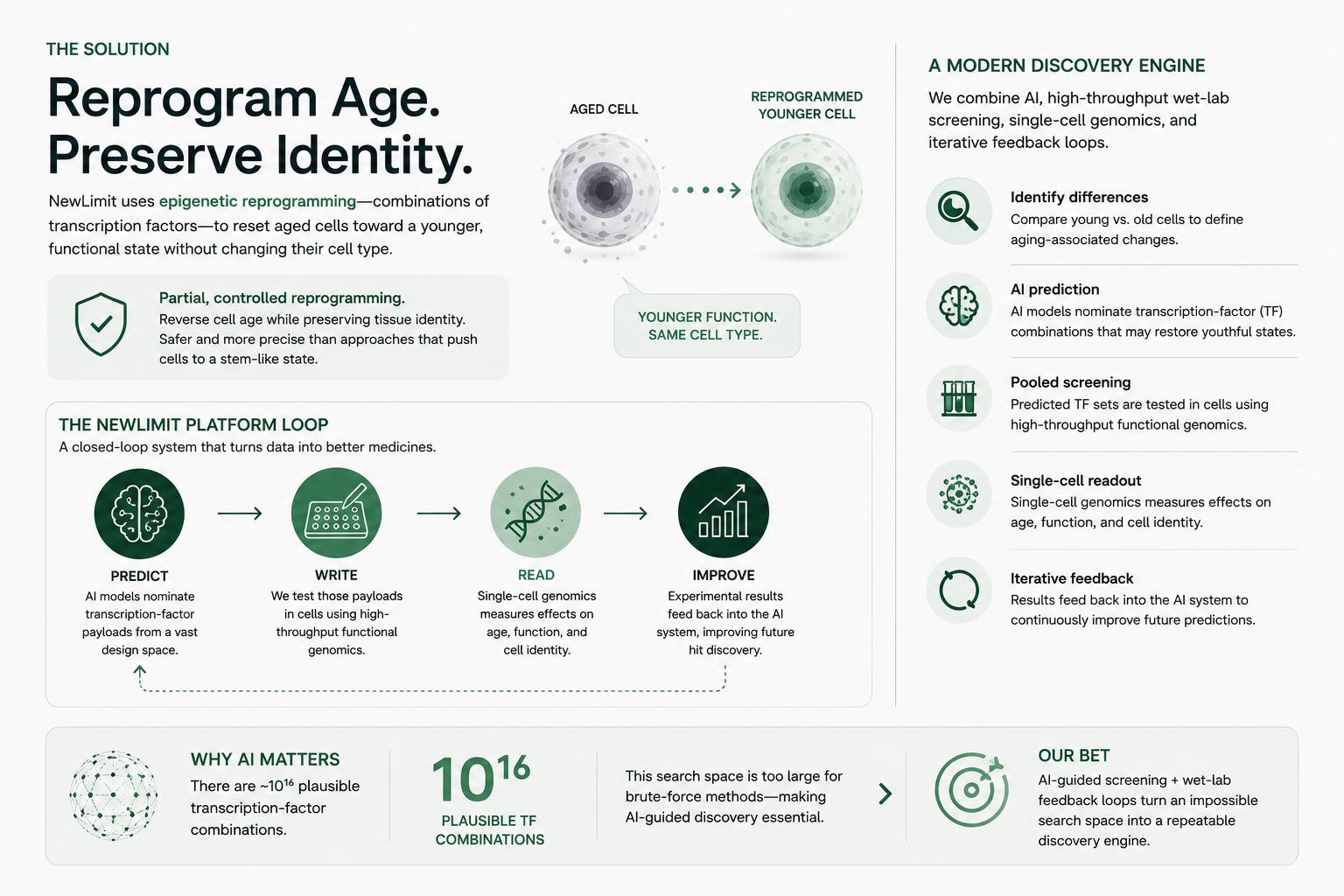
NewLimit’s approach is based on epigenetic reprogramming: using combinations of transcription factors to reset aged cells toward a younger functional state without changing their cell type.
This distinction is important. Earlier cellular reprogramming work showed that transcription factors could push mature cells toward stem-like states. That is scientifically powerful but potentially dangerous for therapeutics, because cells that lose identity may behave unpredictably. NewLimit is attempting a more controlled form of partial reprogramming: reverse cell age while preserving tissue identity.
The company’s discovery system combines AI, high-throughput wet-lab screening, single-cell genomics, and iterative feedback loops. First, NewLimit identifies differences between young and old cells. Then its AI system nominates transcription-factor combinations that may restore youthful cell states. Those predicted TF sets are tested experimentally using pooled screening systems. The resulting data is read out using single-cell genomics and fed back into the model to improve future predictions.
This creates a platform loop:
The reason AI matters is the size of the search space. NewLimit states that there are approximately 10¹⁶ plausible transcription-factor combinations, making naive brute-force search impossible. The company’s focus is that AI-guided screening plus wet-lab feedback loops can turn that impossible search space into a repeatable discovery engine.
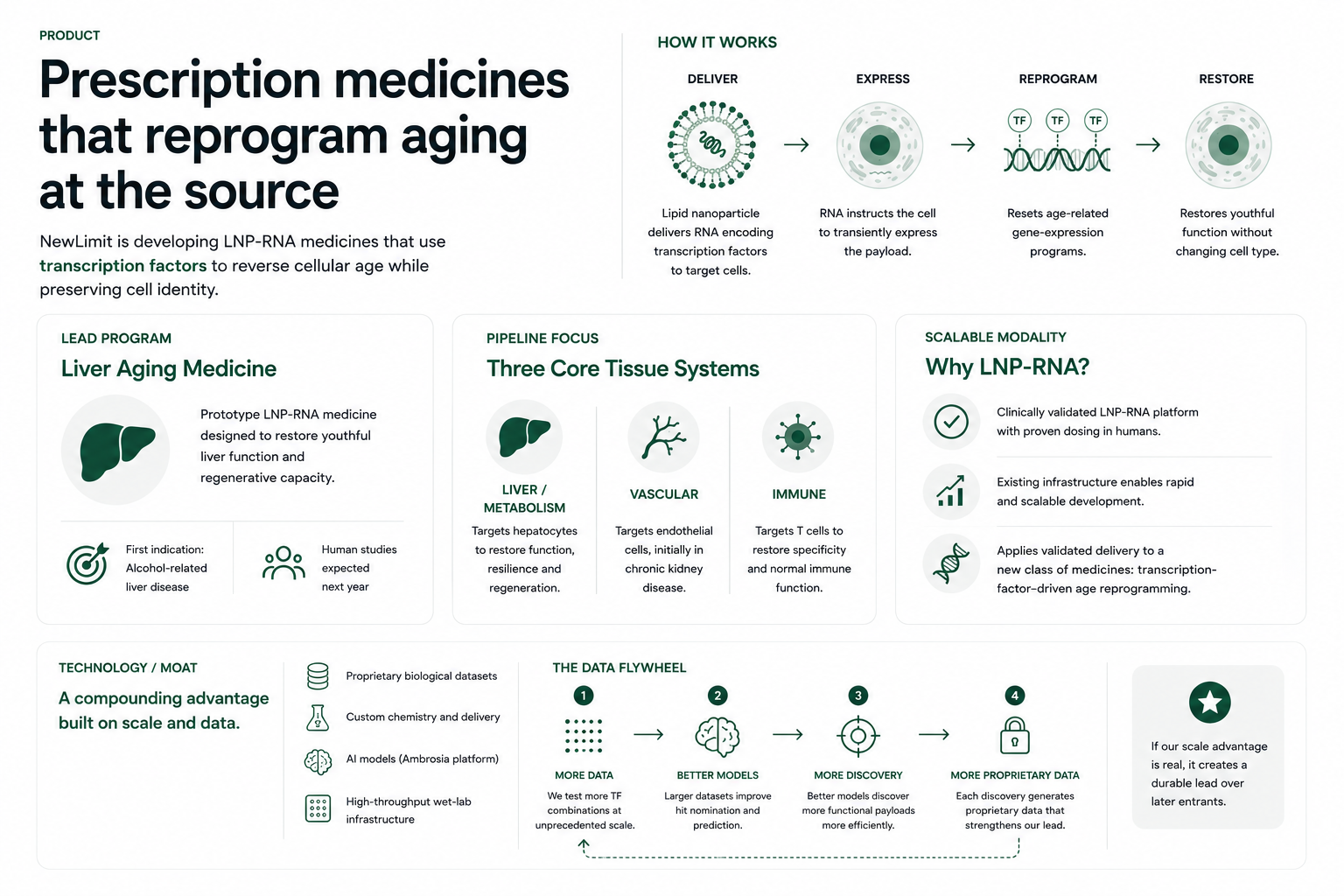
NewLimit is developing prescription medicines, not supplements, diagnostics, or consumer longevity products.
The drug product is an LNP-RNA medicine. A lipid nanoparticle delivers RNA encoding a transcription-factor protein payload to specific cells. The RNA instructs the target cell to transiently express the payload, with the goal of resetting age-related gene-expression patterns and restoring youthful function. Public reporting has described NewLimit’s lead candidate as an mRNA/LNP liver-rejuvenation medicine, with the goal of pushing it into human trials. Fierce Biotech described the program as a liver mRNA medicine, while Pharmaphorum described the prototype drug as lipid nanoparticle-delivered RNA coding for transcription factors.
NewLimit argues that this modality is scalable from day one because LNP-RNA drugs are already clinically validated and have been dosed widely through existing RNA medicine infrastructure. The company is applying that delivery architecture to a new therapeutic category: transcription-factor-driven age reprogramming.
The lead program is a prototype liver aging medicine designed to restore youthful liver function and regenerative capacity. Public reporting indicates the first drug candidate is aimed at alcohol-related liver disease, with human studies expected next year.
NewLimit’s public pipeline focus includes three core tissue systems:
The lead program targets hepatocytes, the primary functional cells of the liver. NewLimit describes old hepatocytes as less resilient, worse at regenerating after injury, and more vulnerable to metabolic and toxic stress. NewLimit’s goal is to restore youthful hepatocyte function.
The vascular program is focused on endothelial cells, initially in chronic kidney disease. NewLimit describes its vascular team as developing reprogramming medicines to rescue endothelial function, initially focused on rejuvenating endothelial cells in the kidney.
The immune program is focused on T cells and inflammatory diseases of aging. NewLimit describes older T cells as less specific and more inflammatory, with the company working to restore specificity and normal immune function.
NewLimit’s core moat appears to be the combination of proprietary biological datasets, custom chemistry, AI models, and high-throughput wet-lab infrastructure. The company argues that scaling laws apply in reprogramming biology: larger transcription-factor screening datasets improve hit nomination and effect prediction. NewLimit has publicly described Ambrosia as its in silico reprogramming framework and has published technical work on using AI models to design epigenetic reprogramming payloads.
If this data-scaling thesis is correct, it creates a potential compounding advantage. The more TF sets NewLimit tests, the better its models become; the better its models become, the more efficiently it can discover functional payloads; and the more functional payloads it discovers, the more proprietary data it generates.
This creates a potential advantage over later entrants, especially if the company’s claimed scale lead is accurate.
NewLimit claims to have screened 1,200x more transcription-factor protein sets than all other aging companies and labs combined. This is one of the strongest platform claims in the company’s materials, though it should be independently diligence-tested.
The company says its discovery loop has generated more than 100 age-reprogramming TF hits, using AI models to nominate TF sets, wet-lab screening to validate them, and feedback loops to improve future predictions. Kleiner Perkins previously wrote that NewLimit had discovered 100+ reprogramming payloads and three prototype medicines that treat animal models of liver disease.
NewLimit also claims that its AI-guided discovery process has doubled the rate of discovery versus baseline approaches. The company reports year-on-year improvements including 2.8x more TF hits per FTE and 14x more preclinical hits per dollar. It also claims that AI improvements are producing more prototype medicines per dollar, including more TF sets tested, higher phenotypic hit rates, lower cost per functional hit, and more functional hits.
In preclinical work, NewLimit says its prototype liver aging medicine restored regenerative function in human cells and mice. In old mice exposed to alcohol injury models, treated animals reportedly showed improved metabolic resilience, lower liver damage markers, and significantly longer survival during chronic ethanol challenge versus controls.
The company previously wrote that it had discovered TF sets that made old hepatocytes both look and act young, formulated the top hit into a prototype LNP-mRNA medicine, and demonstrated restored youthful function in a preclinical model of liver disease.
The company also reports that liver aging payloads were safe and tolerated in young animals dosed weekly for eight weeks at 0.3 mg/kg, which it describes as four times the intended frequency. Full drug safety profiling remains ongoing, and this remains a central diligence area.
The company is targeting human trials for its first liver aging medicine by 2027. STAT reported that NewLimit plans to launch its first clinical trial of a liver medicine after the Series C, while Fierce Biotech reported that the company plans to push into a Phase 1 fatty liver disease trial next year.
NewLimit’s team is strong for a preclinical biotech because it combines company-building, software, AI, biology, and translational medicine.
Kimmel is a stem-cell biologist and former Calico scientist. NewLimit’s company page states that he previously led a research laboratory focused on epigenetic reprogramming as a Principal Investigator at Calico, where his program developed methods to engineer cell identity and reprogram cell age.
Armstrong is the co-founder and CEO of Coinbase. NewLimit’s company page highlights his experience in software, machine learning, organization design, fundraising, leadership, and team building. The original founder-funded seed commitment also signals high conviction and long-duration risk tolerance.
Byers is a scientist and investor, formerly a General Partner at GV. NewLimit’s company page describes him as a scientist and startup investor with a PhD in bioengineering from Stanford and prior investments across companies including OpenAI, Anthropic, xAI, Neuralink, Chai Discovery, OpenEvidence, and others.
Calton leads therapeutic programs from validation through the clinic. NewLimit states that she previously served as VP of Early-Stage Product Development at 4D Molecular Therapeutics and led preclinical development and IND-enabling studies across multiple therapeutic areas.
Hause leads computational biology and predictive modeling. NewLimit states that he was previously SVP and Head of AI at Shape Therapeutics and led cell therapy informatics and predictive sciences at Juno, Celgene, and BMS.
The company also has scientific advisors across immunology, nephrology, liver biology, gene therapy, and translational medicine. This advisory bench is important because NewLimit’s success depends not only on discovering payloads, but also on safely translating them into human tissue-specific medicines.
Founder Commitment / Seed (2021)
Amount: $110M
Valuation: Not publicly disclosed
Backers: Brian Armstrong and Blake Byers / founders
Series A (May 2023)
Amount: $40M
Valuation: Not publicly disclosed
Backers: Dimension, Founders Fund, Kleiner Perkins, Eric Schmidt, Elad Gil, Garry Tan, Fred Ehrsam
Reference: NewLimit Series A announcement
Series B (May 2025)
Amount: $130M
Valuation: Approximately $810M
Backers: Kleiner Perkins, Nat Friedman / Daniel Gross, Khosla Ventures, Human Capital, Valor Equity Partners, Founders Fund, Dimension
Reference: NewLimit Series B announcement
Series B Extension (October 2025)
Amount: $45M
Valuation: Approximately $1.62B valuation cap
Backers: Eli Lilly Ventures, Duke Management Co., Section 32, and returning investors
Reference: NewLimit Series B extension announcement
Series C (June 2026)
Amount: $435M
Valuation: Approximately $3.1B post-money
Backers: Founders Fund, Thrive Capital, Greenoaks, Quiet Capital, Kleiner Perkins, Abstract, Nat Friedman / Daniel Gross, Valor Equity Partners, Eli Lilly Ventures, Human Capital, and others
Reference: NewLimit Series C announcement; Yahoo / Quartz valuation report
NewLimit states it has enough cash to operate through 2030 and is raising the Series C based on faster-than-expected progress. The company states that major milestones are fully funded, including one liver aging medicine in trials by 2027, five cell-type franchises underway by 2028, three medicines in trials by 2029, and four medicines in trials plus a liver v1 efficacy readout by 2030.
NewLimit is targeting the intersection of longevity medicine, age-related disease, RNA therapeutics, and AI-driven drug discovery. The near-term market is not “aging” as a regulatory indication. Aging itself is not generally treated as an approvable disease category. Instead, NewLimit is likely to enter through recognized disease indications where age-related cellular dysfunction is central.
The initial liver indication is alcohol-related liver disease. Public reporting states that NewLimit’s first drug candidate is aimed at alcohol-related liver disease. NewLimit claims ALD affects approximately 2% of the U.S. population, causes more than 30,000 U.S. deaths per year, has approximately 50% five-year survival, and lacks an effective standard of care. The company estimates the ALD opportunity at approximately $20 billion, with expansion potential above $100B as the liver franchise broadens beyond alcohol-related liver disease into adjacent liver and metabolic indications.
The vascular program is expected to start in chronic kidney disease. NewLimit frames CKD as a long-term, irreversible loss of kidney function affecting approximately 14% of the U.S. population. The company estimates the CKD opportunity at approximately $60B, with potential expansion into cardiovascular health and cognitive decline.
NewLimit compares aging medicines to GLP-1 drugs. The analogy is that GLP-1s created roughly $1 trillion of enterprise value for Eli Lilly and Novo Nordisk despite treating only a subset of the global population. NewLimit argues aging medicines could ultimately be larger because, in principle, everyone experiences aging.
The broader market for longevity and anti-aging therapeutics is still early and definitions vary. Mordor Intelligence estimates the senolytics and anti-aging pharmaceuticals market will grow from $9.06 billion in 2025 to $14.33B by 2031. The company believes each successful tissue-specific aging program could be worth $100B+, with the liver franchise alone potentially exceeding $100B after expansion beyond the initial alcohol-related liver disease wedge. This is a large but early market. The key question is whether tissue-specific reprogramming can move from preclinical promise to safe, repeatable, approved human medicines.
NewLimit’s “why now” is the convergence of epigenetic reprogramming, AI-guided discovery, and scalable LNP-RNA delivery. The company argues that there are approximately 10¹⁶ plausible transcription-factor combinations, making naive search intractable. Prior to AI, the search space was effectively impossible to explore. NewLimit’s science page states that this search space is too large to brute force and that Ambrosia is designed to prioritize payloads expected to make old cells look and act young.
Three enabling factors have matured at the same time:
Epigenetic reprogramming
The science now suggests that aspects of cellular aging may be reversible through partial reprogramming, provided cell identity is preserved.
AI-guided discovery
Large biological datasets and modern AI models can help nominate TF combinations that would be impossible to find through manual screening. NewLimit’s Ambrosia research describes an in silico system for designing epigenetic reprogramming payloads.
Scalable LNP-RNA delivery
The broader RNA medicine ecosystem has validated lipid nanoparticle delivery, manufacturing, and clinical development paths. NewLimit is applying that infrastructure to transcription-factor reprogramming payloads.
The combination of these three trends creates the possibility of a repeatable discovery and development engine for tissue-specific aging medicines.
NewLimit competes with other longevity, cellular reprogramming, and aging-biology companies.
Altos Labs
Altos Labs is one of the best-funded players in cellular rejuvenation. It launched with approximately $3B in funding and is focused on restoring cell health through cellular rejuvenation programming. Altos has recruited major scientific leadership and built a research-institute-like structure.
Compared with Altos, NewLimit appears more product- and platform-execution-oriented, with a clearer near-term focus on specific therapeutic programs. Altos may have a broader scientific base and more capital, while NewLimit appears more tightly oriented around AI-guided payload discovery and clinical translation.
Retro Biosciences
Retro Biosciences is another high-profile longevity company. Public reporting has described Retro as backed by Sam Altman and valued at approximately $1.8 billion. Retro is pursuing multiple approaches to extend healthy lifespan.
Compared with Retro, NewLimit is more specifically focused on partial epigenetic reprogramming and transcription-factor payload discovery. Retro appears broader by modality, while NewLimit is more concentrated around a specific platform thesis.
Life Biosciences
Life Biosciences is a direct scientific comparator because it is also pursuing partial epigenetic reprogramming. In January 2026, Life Biosciences announced FDA clearance of an IND for ER-100, which it described as the first cellular rejuvenation therapy using partial epigenetic reprogramming to reach human clinical trials.
Life Bio is ahead clinically in partial reprogramming, but its lead program is focused on optic neuropathies. NewLimit’s lead disclosed program is liver-focused, with broader ambitions across vascular and immune systems. The relevant question is whether NewLimit’s systemic LNP-RNA approach can safely expand to larger indications beyond locally delivered eye therapies.
Traditional Pharma and Biotech
If NewLimit demonstrates credible human proof-of-concept, large pharmaceutical companies may become competitors, partners, or acquirers. Eli Lilly Ventures’ participation in the cap table is a notable signal that large pharma is watching the category.
NewLimit claims it is far ahead of other aging companies and labs based on the scale of TF protein set screening, stating that it has screened 1,200x more TF protein sets than all other aging companies and labs combined. If accurate, this suggests a potentially meaningful data and experimentation advantage. However, this claim should be independently diligence-tested. The key competitive question is whether NewLimit is meaningfully ahead in a compounding data advantage, or whether several well-funded groups will converge on similar reprogramming payloads, delivery systems, and indications.
NewLimit proves that TF-based LNP-RNA reprogramming can safely restore youthful tissue function in humans. The liver program demonstrates target engagement, functional improvement, acceptable safety, and a path toward efficacy in alcohol-related liver disease or adjacent liver indications. The platform then expands into vascular and immune programs, creating multiple tissue-specific aging franchises. In this scenario, NewLimit becomes the category leader in aging medicines, with several potential $100B+ opportunities and strategic value to large pharma.
NewLimit remains one of the leading longevity biotech companies, but clinical translation is slower and more complicated than expected. The first liver trial shows acceptable safety and some biomarker movement, but efficacy is not immediately definitive. The company continues to progress multiple programs, but requires additional time, capital, and clinical validation before the platform is fully proven. In this scenario, NewLimit remains valuable, but the near-term upside from the current valuation may be more limited unless the company generates strong human proof-of-mechanism data.
NewLimit’s platform works in cells and mice but fails to translate cleanly into humans. Potential failure modes include weak efficacy, poor durability, off-target delivery, immune response, tumor risk, loss of cell identity, unacceptable toxicity, or inability to show clinically meaningful benefit. In this scenario, the company could still retain valuable biology and data assets, but the current valuation would likely be difficult to support. The biggest bear-case risk is that NewLimit is priced like a platform company before proving that the platform can safely and repeatably work in humans.
NewLimit is a high-conviction, high-risk, high-upside biotechnology company attempting to build one of the first scalable discovery engines for age-reprogramming medicines.
The bull case is that NewLimit has built a proprietary loop combining human tissue data, AI-guided transcription-factor prediction, high-throughput wet-lab validation, LNP-RNA delivery, and early preclinical evidence in liver aging. If the platform translates into humans, the company could own a new category of tissue-specific aging medicines with multiple $100B+ franchise opportunities.
The company’s strongest points are:
Round
Tender at $3.3B
Investors
Founders Fund, Thrive, Greenoaks, Kleiner , Khosla , Eli Lilly Ventures, Dimension, Nat Friedman & Daniel Gross, Eric Schmidt, Elad Gil, Garry Tan, Fred Ehrsam, Brian Armstrong, Blake Byers
Date
30th June
Questions
team@joinbeyond.coMemo
NewLimit is a biotechnology company developing “aging medicines” using epigenetic reprogramming, with the ambition of restoring youthful function in specific tissues rather than merely slowing age-related decline.
The company’s stated mission is to “radically extend human healthspan.” Its core thesis is that aging can be treated at the cellular level by reprogramming the epigenome: resetting aged cells toward a more youthful functional state while preserving their identity as liver cells, immune cells, vascular cells, or other mature tissue types.
NewLimit’s long-term goal is to build medicines that add many healthy years of life across liver, vascular, immune, and other aging-related systems. If successful, NewLimit could create a new category of tissue-specific aging medicines, starting with liver disease and expanding into other major age-related disease areas.
The company was founded by Jacob Kimmel (epigenetic reprogramming at Calico), Brian Armstrong (co-founder and CEO of Coinbase), and Blake Byers (scientist, investor, and former GV partner). NewLimit is now one of the best-funded companies in longevity biotech, following a $435 million Series C in June 2026 at a reported valuation of approximately $3.1 billion.
Aging is an upstream driver of many major diseases. NewLimit frames age-related cellular dysfunction as a root cause behind many of the conditions that dominate healthcare spending, including cancer, metabolic disease, liver disease, kidney disease, cardiovascular disease, immune dysfunction, and neurodegeneration.
The company claims that an 80-year-old versus a 20-year-old is approximately 150x more likely to die of cancer and 200x more likely to die of any major disease. The implication is that treating individual diseases one-by-one may miss the deeper biological driver: the progressive loss of cellular function with age.
At the cellular level, NewLimit’s premise is that aging is driven in part by degradation of epigenetic marks. NewLimit explains that epigenetic marks tell cells which genes to use, and that these marks degrade with age. As these marks degrade, cells can lose youthful gene-expression programs, become less resilient, and function less effectively. In the liver, this may mean impaired regeneration and worse response to metabolic or toxic stress. In the vasculature, it may mean endothelial dysfunction. In the immune system, it may mean chronic inflammation and reduced pathogen clearance.
If age-related cellular dysfunction can be reversed in specific tissues, NewLimit believes this could address multiple disease categories through one underlying biological mechanism. This is the core reason the company views aging medicines as potentially much larger than traditional single-indication therapeutics.
NewLimit’s approach is based on epigenetic reprogramming: using combinations of transcription factors to reset aged cells toward a younger functional state without changing their cell type.
This distinction is important. Earlier cellular reprogramming work showed that transcription factors could push mature cells toward stem-like states. That is scientifically powerful but potentially dangerous for therapeutics, because cells that lose identity may behave unpredictably. NewLimit is attempting a more controlled form of partial reprogramming: reverse cell age while preserving tissue identity.
The company’s discovery system combines AI, high-throughput wet-lab screening, single-cell genomics, and iterative feedback loops. First, NewLimit identifies differences between young and old cells. Then its AI system nominates transcription-factor combinations that may restore youthful cell states. Those predicted TF sets are tested experimentally using pooled screening systems. The resulting data is read out using single-cell genomics and fed back into the model to improve future predictions.
This creates a platform loop:
The reason AI matters is the size of the search space. NewLimit states that there are approximately 10¹⁶ plausible transcription-factor combinations, making naive brute-force search impossible. The company’s focus is that AI-guided screening plus wet-lab feedback loops can turn that impossible search space into a repeatable discovery engine.
NewLimit is developing prescription medicines, not supplements, diagnostics, or consumer longevity products.
The drug product is an LNP-RNA medicine. A lipid nanoparticle delivers RNA encoding a transcription-factor protein payload to specific cells. The RNA instructs the target cell to transiently express the payload, with the goal of resetting age-related gene-expression patterns and restoring youthful function. Public reporting has described NewLimit’s lead candidate as an mRNA/LNP liver-rejuvenation medicine, with the goal of pushing it into human trials. Fierce Biotech described the program as a liver mRNA medicine, while Pharmaphorum described the prototype drug as lipid nanoparticle-delivered RNA coding for transcription factors.
NewLimit argues that this modality is scalable from day one because LNP-RNA drugs are already clinically validated and have been dosed widely through existing RNA medicine infrastructure. The company is applying that delivery architecture to a new therapeutic category: transcription-factor-driven age reprogramming.
The lead program is a prototype liver aging medicine designed to restore youthful liver function and regenerative capacity. Public reporting indicates the first drug candidate is aimed at alcohol-related liver disease, with human studies expected next year.
NewLimit’s public pipeline focus includes three core tissue systems:
The lead program targets hepatocytes, the primary functional cells of the liver. NewLimit describes old hepatocytes as less resilient, worse at regenerating after injury, and more vulnerable to metabolic and toxic stress. NewLimit’s goal is to restore youthful hepatocyte function.
The vascular program is focused on endothelial cells, initially in chronic kidney disease. NewLimit describes its vascular team as developing reprogramming medicines to rescue endothelial function, initially focused on rejuvenating endothelial cells in the kidney.
The immune program is focused on T cells and inflammatory diseases of aging. NewLimit describes older T cells as less specific and more inflammatory, with the company working to restore specificity and normal immune function.
NewLimit’s core moat appears to be the combination of proprietary biological datasets, custom chemistry, AI models, and high-throughput wet-lab infrastructure. The company argues that scaling laws apply in reprogramming biology: larger transcription-factor screening datasets improve hit nomination and effect prediction. NewLimit has publicly described Ambrosia as its in silico reprogramming framework and has published technical work on using AI models to design epigenetic reprogramming payloads.
If this data-scaling thesis is correct, it creates a potential compounding advantage. The more TF sets NewLimit tests, the better its models become; the better its models become, the more efficiently it can discover functional payloads; and the more functional payloads it discovers, the more proprietary data it generates.
This creates a potential advantage over later entrants, especially if the company’s claimed scale lead is accurate.
NewLimit claims to have screened 1,200x more transcription-factor protein sets than all other aging companies and labs combined. This is one of the strongest platform claims in the company’s materials, though it should be independently diligence-tested.
The company says its discovery loop has generated more than 100 age-reprogramming TF hits, using AI models to nominate TF sets, wet-lab screening to validate them, and feedback loops to improve future predictions. Kleiner Perkins previously wrote that NewLimit had discovered 100+ reprogramming payloads and three prototype medicines that treat animal models of liver disease.
NewLimit also claims that its AI-guided discovery process has doubled the rate of discovery versus baseline approaches. The company reports year-on-year improvements including 2.8x more TF hits per FTE and 14x more preclinical hits per dollar. It also claims that AI improvements are producing more prototype medicines per dollar, including more TF sets tested, higher phenotypic hit rates, lower cost per functional hit, and more functional hits.
In preclinical work, NewLimit says its prototype liver aging medicine restored regenerative function in human cells and mice. In old mice exposed to alcohol injury models, treated animals reportedly showed improved metabolic resilience, lower liver damage markers, and significantly longer survival during chronic ethanol challenge versus controls.
The company previously wrote that it had discovered TF sets that made old hepatocytes both look and act young, formulated the top hit into a prototype LNP-mRNA medicine, and demonstrated restored youthful function in a preclinical model of liver disease.
The company also reports that liver aging payloads were safe and tolerated in young animals dosed weekly for eight weeks at 0.3 mg/kg, which it describes as four times the intended frequency. Full drug safety profiling remains ongoing, and this remains a central diligence area.
The company is targeting human trials for its first liver aging medicine by 2027. STAT reported that NewLimit plans to launch its first clinical trial of a liver medicine after the Series C, while Fierce Biotech reported that the company plans to push into a Phase 1 fatty liver disease trial next year.
NewLimit’s team is strong for a preclinical biotech because it combines company-building, software, AI, biology, and translational medicine.
Kimmel is a stem-cell biologist and former Calico scientist. NewLimit’s company page states that he previously led a research laboratory focused on epigenetic reprogramming as a Principal Investigator at Calico, where his program developed methods to engineer cell identity and reprogram cell age.
Armstrong is the co-founder and CEO of Coinbase. NewLimit’s company page highlights his experience in software, machine learning, organization design, fundraising, leadership, and team building. The original founder-funded seed commitment also signals high conviction and long-duration risk tolerance.
Byers is a scientist and investor, formerly a General Partner at GV. NewLimit’s company page describes him as a scientist and startup investor with a PhD in bioengineering from Stanford and prior investments across companies including OpenAI, Anthropic, xAI, Neuralink, Chai Discovery, OpenEvidence, and others.
Calton leads therapeutic programs from validation through the clinic. NewLimit states that she previously served as VP of Early-Stage Product Development at 4D Molecular Therapeutics and led preclinical development and IND-enabling studies across multiple therapeutic areas.
Hause leads computational biology and predictive modeling. NewLimit states that he was previously SVP and Head of AI at Shape Therapeutics and led cell therapy informatics and predictive sciences at Juno, Celgene, and BMS.
The company also has scientific advisors across immunology, nephrology, liver biology, gene therapy, and translational medicine. This advisory bench is important because NewLimit’s success depends not only on discovering payloads, but also on safely translating them into human tissue-specific medicines.
Founder Commitment / Seed (2021)
Amount: $110M
Valuation: Not publicly disclosed
Backers: Brian Armstrong and Blake Byers / founders
Series A (May 2023)
Amount: $40M
Valuation: Not publicly disclosed
Backers: Dimension, Founders Fund, Kleiner Perkins, Eric Schmidt, Elad Gil, Garry Tan, Fred Ehrsam
Reference: NewLimit Series A announcement
Series B (May 2025)
Amount: $130M
Valuation: Approximately $810M
Backers: Kleiner Perkins, Nat Friedman / Daniel Gross, Khosla Ventures, Human Capital, Valor Equity Partners, Founders Fund, Dimension
Reference: NewLimit Series B announcement
Series B Extension (October 2025)
Amount: $45M
Valuation: Approximately $1.62B valuation cap
Backers: Eli Lilly Ventures, Duke Management Co., Section 32, and returning investors
Reference: NewLimit Series B extension announcement
Series C (June 2026)
Amount: $435M
Valuation: Approximately $3.1B post-money
Backers: Founders Fund, Thrive Capital, Greenoaks, Quiet Capital, Kleiner Perkins, Abstract, Nat Friedman / Daniel Gross, Valor Equity Partners, Eli Lilly Ventures, Human Capital, and others
Reference: NewLimit Series C announcement; Yahoo / Quartz valuation report
NewLimit states it has enough cash to operate through 2030 and is raising the Series C based on faster-than-expected progress. The company states that major milestones are fully funded, including one liver aging medicine in trials by 2027, five cell-type franchises underway by 2028, three medicines in trials by 2029, and four medicines in trials plus a liver v1 efficacy readout by 2030.
NewLimit is targeting the intersection of longevity medicine, age-related disease, RNA therapeutics, and AI-driven drug discovery. The near-term market is not “aging” as a regulatory indication. Aging itself is not generally treated as an approvable disease category. Instead, NewLimit is likely to enter through recognized disease indications where age-related cellular dysfunction is central.
The initial liver indication is alcohol-related liver disease. Public reporting states that NewLimit’s first drug candidate is aimed at alcohol-related liver disease. NewLimit claims ALD affects approximately 2% of the U.S. population, causes more than 30,000 U.S. deaths per year, has approximately 50% five-year survival, and lacks an effective standard of care. The company estimates the ALD opportunity at approximately $20 billion, with expansion potential above $100B as the liver franchise broadens beyond alcohol-related liver disease into adjacent liver and metabolic indications.
The vascular program is expected to start in chronic kidney disease. NewLimit frames CKD as a long-term, irreversible loss of kidney function affecting approximately 14% of the U.S. population. The company estimates the CKD opportunity at approximately $60B, with potential expansion into cardiovascular health and cognitive decline.
NewLimit compares aging medicines to GLP-1 drugs. The analogy is that GLP-1s created roughly $1 trillion of enterprise value for Eli Lilly and Novo Nordisk despite treating only a subset of the global population. NewLimit argues aging medicines could ultimately be larger because, in principle, everyone experiences aging.
The broader market for longevity and anti-aging therapeutics is still early and definitions vary. Mordor Intelligence estimates the senolytics and anti-aging pharmaceuticals market will grow from $9.06 billion in 2025 to $14.33B by 2031. The company believes each successful tissue-specific aging program could be worth $100B+, with the liver franchise alone potentially exceeding $100B after expansion beyond the initial alcohol-related liver disease wedge. This is a large but early market. The key question is whether tissue-specific reprogramming can move from preclinical promise to safe, repeatable, approved human medicines.
NewLimit’s “why now” is the convergence of epigenetic reprogramming, AI-guided discovery, and scalable LNP-RNA delivery. The company argues that there are approximately 10¹⁶ plausible transcription-factor combinations, making naive search intractable. Prior to AI, the search space was effectively impossible to explore. NewLimit’s science page states that this search space is too large to brute force and that Ambrosia is designed to prioritize payloads expected to make old cells look and act young.
Three enabling factors have matured at the same time:
Epigenetic reprogramming
The science now suggests that aspects of cellular aging may be reversible through partial reprogramming, provided cell identity is preserved.
AI-guided discovery
Large biological datasets and modern AI models can help nominate TF combinations that would be impossible to find through manual screening. NewLimit’s Ambrosia research describes an in silico system for designing epigenetic reprogramming payloads.
Scalable LNP-RNA delivery
The broader RNA medicine ecosystem has validated lipid nanoparticle delivery, manufacturing, and clinical development paths. NewLimit is applying that infrastructure to transcription-factor reprogramming payloads.
The combination of these three trends creates the possibility of a repeatable discovery and development engine for tissue-specific aging medicines.
NewLimit competes with other longevity, cellular reprogramming, and aging-biology companies.
Altos Labs
Altos Labs is one of the best-funded players in cellular rejuvenation. It launched with approximately $3B in funding and is focused on restoring cell health through cellular rejuvenation programming. Altos has recruited major scientific leadership and built a research-institute-like structure.
Compared with Altos, NewLimit appears more product- and platform-execution-oriented, with a clearer near-term focus on specific therapeutic programs. Altos may have a broader scientific base and more capital, while NewLimit appears more tightly oriented around AI-guided payload discovery and clinical translation.
Retro Biosciences
Retro Biosciences is another high-profile longevity company. Public reporting has described Retro as backed by Sam Altman and valued at approximately $1.8 billion. Retro is pursuing multiple approaches to extend healthy lifespan.
Compared with Retro, NewLimit is more specifically focused on partial epigenetic reprogramming and transcription-factor payload discovery. Retro appears broader by modality, while NewLimit is more concentrated around a specific platform thesis.
Life Biosciences
Life Biosciences is a direct scientific comparator because it is also pursuing partial epigenetic reprogramming. In January 2026, Life Biosciences announced FDA clearance of an IND for ER-100, which it described as the first cellular rejuvenation therapy using partial epigenetic reprogramming to reach human clinical trials.
Life Bio is ahead clinically in partial reprogramming, but its lead program is focused on optic neuropathies. NewLimit’s lead disclosed program is liver-focused, with broader ambitions across vascular and immune systems. The relevant question is whether NewLimit’s systemic LNP-RNA approach can safely expand to larger indications beyond locally delivered eye therapies.
Traditional Pharma and Biotech
If NewLimit demonstrates credible human proof-of-concept, large pharmaceutical companies may become competitors, partners, or acquirers. Eli Lilly Ventures’ participation in the cap table is a notable signal that large pharma is watching the category.
NewLimit claims it is far ahead of other aging companies and labs based on the scale of TF protein set screening, stating that it has screened 1,200x more TF protein sets than all other aging companies and labs combined. If accurate, this suggests a potentially meaningful data and experimentation advantage. However, this claim should be independently diligence-tested. The key competitive question is whether NewLimit is meaningfully ahead in a compounding data advantage, or whether several well-funded groups will converge on similar reprogramming payloads, delivery systems, and indications.
NewLimit proves that TF-based LNP-RNA reprogramming can safely restore youthful tissue function in humans. The liver program demonstrates target engagement, functional improvement, acceptable safety, and a path toward efficacy in alcohol-related liver disease or adjacent liver indications. The platform then expands into vascular and immune programs, creating multiple tissue-specific aging franchises. In this scenario, NewLimit becomes the category leader in aging medicines, with several potential $100B+ opportunities and strategic value to large pharma.
NewLimit remains one of the leading longevity biotech companies, but clinical translation is slower and more complicated than expected. The first liver trial shows acceptable safety and some biomarker movement, but efficacy is not immediately definitive. The company continues to progress multiple programs, but requires additional time, capital, and clinical validation before the platform is fully proven. In this scenario, NewLimit remains valuable, but the near-term upside from the current valuation may be more limited unless the company generates strong human proof-of-mechanism data.
NewLimit’s platform works in cells and mice but fails to translate cleanly into humans. Potential failure modes include weak efficacy, poor durability, off-target delivery, immune response, tumor risk, loss of cell identity, unacceptable toxicity, or inability to show clinically meaningful benefit. In this scenario, the company could still retain valuable biology and data assets, but the current valuation would likely be difficult to support. The biggest bear-case risk is that NewLimit is priced like a platform company before proving that the platform can safely and repeatably work in humans.
NewLimit is a high-conviction, high-risk, high-upside biotechnology company attempting to build one of the first scalable discovery engines for age-reprogramming medicines.
The bull case is that NewLimit has built a proprietary loop combining human tissue data, AI-guided transcription-factor prediction, high-throughput wet-lab validation, LNP-RNA delivery, and early preclinical evidence in liver aging. If the platform translates into humans, the company could own a new category of tissue-specific aging medicines with multiple $100B+ franchise opportunities.
The company’s strongest points are: